
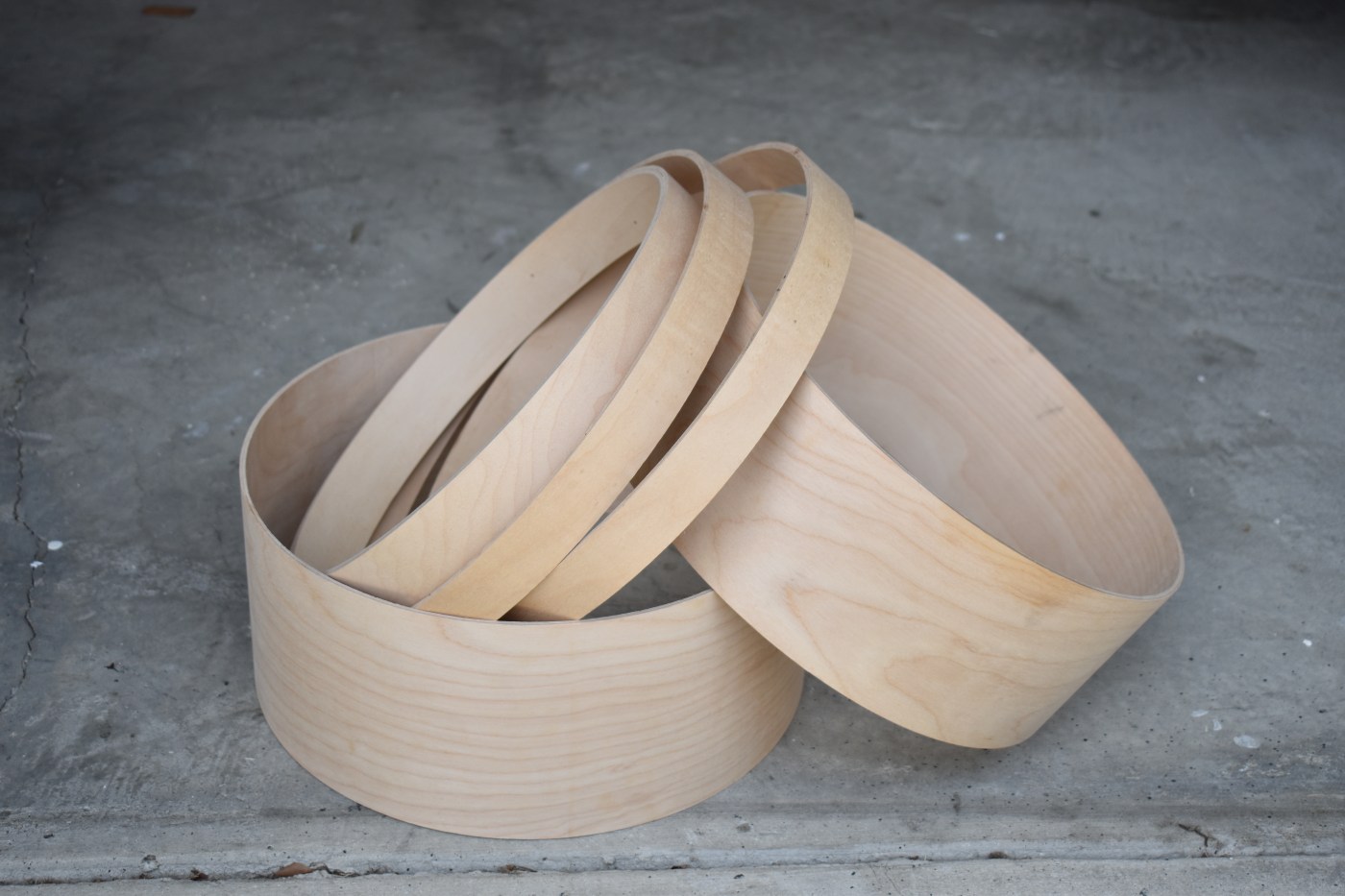
Choosing drum shells is the first step in creating drums. This will play an important role in how your drums will sound in addition to the others (heads, bearing edges, and tuning). With drum shells the two main things you’ll need to consider are shell material and size (diameter/depth). While I’m not covering all types of shell types, I’ll be going through the most common ones for building drums.
Drum Shell Material
Wood Types
By far the most common wood type is probably maple, and for good reason. It sounds good all around, has a nice warm tone with plenty of attack to it. Maple drums can be best described as having a warm tone to it, and good for just about any application.
Birch, probably being second most common is a brighter sound than maple, and can be thought of having more cut in the mix. It has slightly less low-end than maple but can sound like it has a bit more presence.
Mahogany is the least common and has the most low-end. Although because of this, it will have the least amount of presence, but that may be what you’re looking for if you want your drum sound to blend in more with everything else.
There are other woods for drum shells out there such as poplar and luan mahogany, but it’s hard to come across a raw shell with these materials. There is also debate that these are “cheap” woods only used for entry-level kits and they do not sound as good as the other higher quality woods. I’m sure there is some truth to this, but if the drum sounds good to you then the drum sounds good.
Metal Types
There are also different metals to use for drums. Most of the time metal is not used for an entire kit, but rather only snares and things like timbales for the bright, cutting tone. There is nothing wrong with an all metal kit, in fact, there are companies that do that and they sound great.
Steel is like the maple of the metal drum world. It’s a good general purpose shell material and very commonly used. It has a nice bright, cutting tone to it that isn’t too shrill. Steel snares have a nice controlled and loud crack to it.
Brass is common as well, and is very warm sounding compared to the other metals. Has a bit more tone and life than other metals, yet with almost a darker timbre to it. To me, this is almost a good snare if you want to bridge the gap between metal and wood.
Aluminum is less common than the other two but still available from many manufacturers. The sound of an aluminum shell compared to brass and steel is more dry with less overtones. Think of it as a drum that doesn’t need as much external dampening such as pieces of tape, or a wallet on top.
Drum Shell Size
For drum shell size, the basic idea is the bigger the diameter of the shell, the bigger and lower pitched the drum will sound. A 10″ tom will naturally be higher pitched than a 12″ tom. Of course you can tweak tuning to make either sound lower or higher, but the size of the drum will restrict how much low/high tone you can get out of the drum.
In terms of the depth, the longer a drum shell is, the more sustain it will have. A shorter depth will have less sustain and more punch. Depending on what type of music you play or your preference for how you want them to sound, you can choose shorter depths to give that nice quick sound, or a long sustaining tone with more depth in the shell.
 Fountain Drums
Leave a comment